

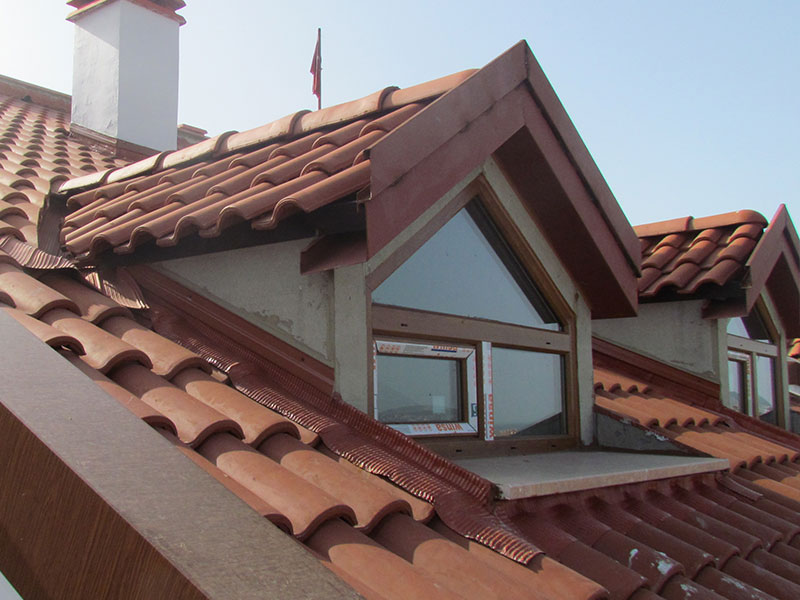
The differences between Marseille, Turkish, flat and concrete tiles, and which to choose for a given pitch, climate and architecture.
Choosing a tile usually starts with colour, when what really decides it is roof pitch, local climate and the architecture of the building. A poor match creates water problems even with the best material.
Marseille (interlocking) tile
Channels at the edges lock the pieces together. The most common type in Türkiye, safe at medium and high pitches, with a wide colour range.
Turkish (alaturka) tile
Curved, single piece, traditional. Visually the best fit for historic fabric. Because the pieces do not interlock it is more sensitive to wind, so the waterproofing beneath matters more than usual.
Flat tile
Favoured by modern architecture: flat faced with sharp lines, reading almost as a single surface from a distance. Its pitch tolerance is narrower, so the manufacturer’s minimum pitch must be respected.
Concrete tile
Cement based rather than fired clay. Dimensionally more regular and usually cheaper. Its colour comes from a surface coating, so it can fade more over many years.
Three questions before choosing
- What is the pitch? The fastest way to narrow the options. At low pitch, consider a seam roof rather than insisting on tile.
- What is the climate? Frost resistance and water absorption in cold regions; tile clips and fixing frequency in windy ones.
- What does the building say? Fitting in with neighbouring roofs is a question of value as well as looks.
Get a Free Quote
Have a question about your roof? Survey and quotation are free.